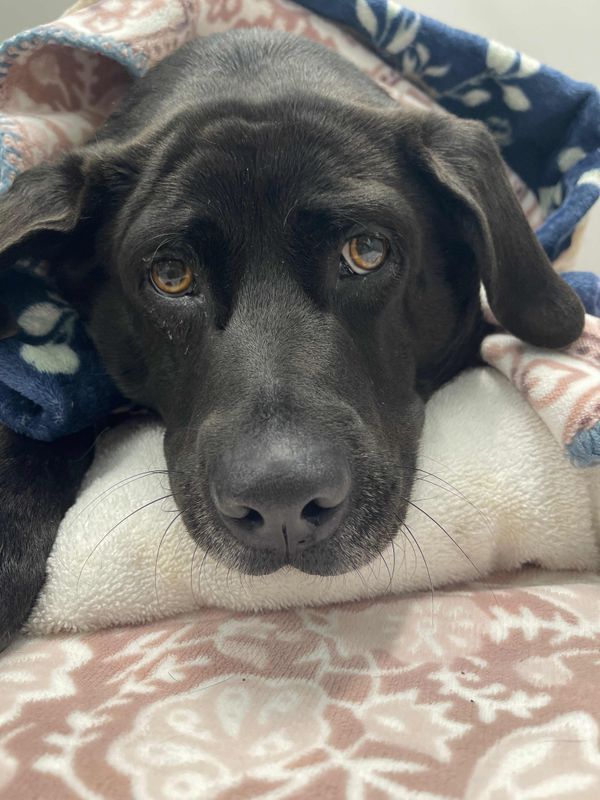
This time of year always carries a strange tension. Everywhere we turn, there’s a push to wrap things up, meet goals, close loops, and sprint toward the finish line of the calendar year.
At the same time, nature is doing the complete opposite — slowing, quieting, resting. Days get darker earlier, mornings start a bit softer, and the world around us signals a shift toward stillness.
And in the middle of this tension, Piper — my endlessly energetic, always-ready-to-run dog — tore her CCL and needed surgery.
Suddenly, “slowing down” was no longer a philosophical suggestion. It was the only option.
The Pace of Healing Is Not Negotiable
We’re still in the early days of Piper’s recovery. The first week in fact.
The phase where movement is very limited, routines are super structured, and patience is not optional. And we are tired…and bored….
Everything right now is deliberate: shorter steps, quieter moments, intentional rest. And as much as Piper resists slowing down, I’ve realized, at times, I do too.
Healing has a pace and it’s not something we get to override.
There is something humbling about being forced to match someone else’s slower rhythm. Especially when you’re used to moving fast, juggling responsibilities, or operating at a constant level of urgency. Caregiving has a way of stripping life (and leadership) down to essentials:
- Presence over productivity
- Gentleness over control
- Awareness over assumption
It asks us to tune into someone else’s needs with a level of attention we often forget to give ourselves.
Patience Isn’t Passive. It’s Intentional
One of the biggest lessons I’ve relearned is that patience isn’t about waiting for something to happen. It’s about how you exist during the waiting.
Patience is a discipline — a choice we make moment by moment.
When I slow down enough to walk gently beside Piper, what I’m really practicing is a kind of leadership that often gets overshadowed by the more glamorous qualities:
- Consistency
- Compassion
- Restraint
- Protection
- Presence
These qualities don’t usually make headlines. They don’t show up in performance evaluations or quarterly goals. But they sustainably shape how we show up for others and for ourselves.
Caregiving as a Leadership Mirror
Caregiving has a way of revealing our real leadership tendencies.
It exposes whether we push too hard, rush too quickly, or assume progress means constant motion. It highlights how often we override our own limits, stretch ourselves thin, or try to force things back to “normal.”
With Piper, there is no rushing. There’s only the pace her healing body can tolerate.
And in that, I’ve noticed my own healing pace too. I noticed how tired I’ve been and how rarely I’ve given myself permission to pause.
Caring for her is also caring for the part of myself that forgets to rest.
The End of the Year Doesn’t Have To Be a Sprint
As we move deeper into this season (you know the one that is culturally framed as busy, frantic, celebratory, demanding), Piper’s recovery has become an unexpected permission slip.
It reminds me:
- Not every expectation is worth carrying.
- Not every tradition has to be kept exactly the same.
- Not every “yes” is required.
- Not every season needs to be productive to be meaningful.
Nature slows down right now. Maybe we should too.
What Slowing Down Gives Back
In the quieter days of Piper’s healing process, I’ve noticed moments I would have missed:
- The soft way she presses her head into my hand when I am near her.
- The mindfulness of each careful step she takes.
- The deep exhale she does when she really relaxes.
- The way rest teaches trust.
- The unexpected sweetness of smaller, quieter routines.
These are moments you only catch when you’re not rushing to the next thing.
And honestly? They’re the moments that feel like real life. The kind of moments I don’t want to speed past anymore.
Slowing Down Isn’t Falling Behind
If there is one lesson I’m holding onto, it’s this:
Slowing down isn’t falling behind. It’s recalibrating. Realigning. Re-anchoring.
Sometimes slowing down is the only thing that keeps us from breaking. Sometimes it’s how we find clarity. Sometimes it’s how we reconnect with the people (or pups) who matter most. And sometimes, slowing down is how we learn to lead with more empathy, more wisdom, and more humanity.
As Piper continues to heal, I know our routines will shift again. We’ll slowly add walks, rebuild strength, and reintroduce movement.
But I hope one thing stays the same: This softer pace. This deeper presence. This reminder that healing and growth aren’t always loud or fast. Often they are quiet, slow, and tender.
And that’s more than enough.